For organizers
Your grounds, finally measured.
You know your gate. You have never known your grounds: what sold where, when the lines broke, which vendor carried the night. Serve Butler runs the ordering and the money, and gives you the data as a by-product.
What you get
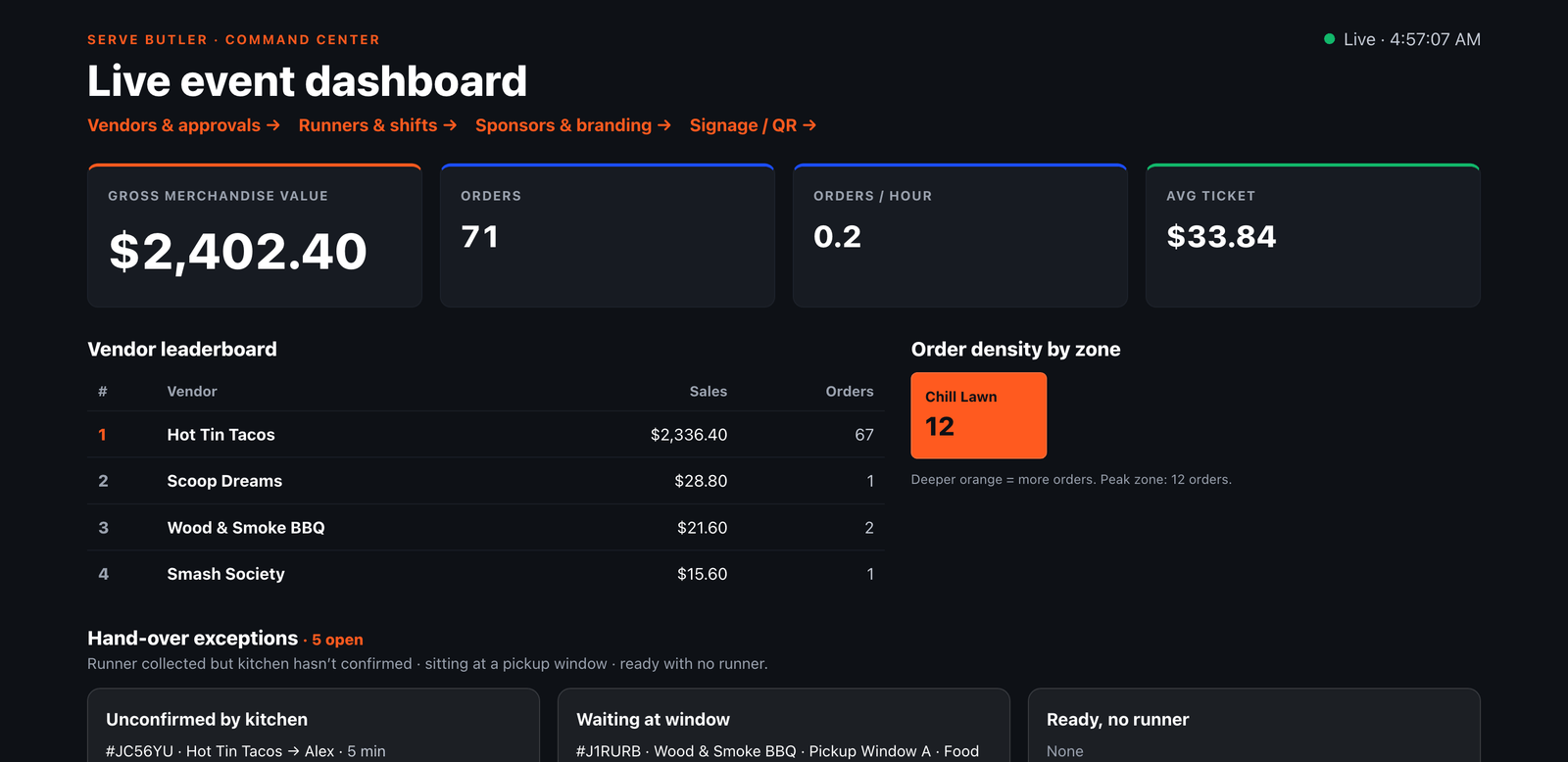
Live command center
Orders, kitchens and runners as they happen. Exceptions surface themselves: a kitchen gone quiet, a hand-over nobody confirmed, an order waiting at a window.
Vendor roster & approvals
Vendors apply from their phone with menu and photos, connect payouts themselves, and go live only when you approve them and assign a booth.
Runner shifts & custody
Publish shifts with pay and station; runners claim and check in. Every carried order has a scan at pickup, a kitchen confirmation and a code at hand-off.
Settlement you can read
An append-only ledger reconciled against Stripe. What moved, what is owed, what paid out, and your share, without a spreadsheet.
Post-event report
Sales by vendor and hour, order density on your site map, mobile share of transactions, runner performance. Forward it to a sponsor.
The signage kit
Print-ready codes for every booth and zone, with placement guidance built on scan research: where boredom lives, at eye level, matte, with the URL printed under the code.
Why it pays
Lines are abandoned sales.
In Oracle's fan research, 42% of US fans skipped buying food or drink in the past year because the line was too long, and more than 80% of baseball fans have walked away from a concession line. Venues that added mobile ordering and pickup report per-person spend gains in the mid-teens to thirty percent. We put the second lane on your grounds and count it.
Sources: Oracle "Stadium of the Future" research (2019, 2021); Mashgin MLB fan report (2025); published venue results from Aramark (Paycor Stadium) and Mercedes-Benz Stadium. Results vary by event; we agree the metrics with you before doors.
How a pilot runs
Walk the grounds
We map booths, pickup windows and VIP zones with you, plan connectivity, and agree the metrics in writing.
Load the vendors
Vendors onboard from their phones in about fifteen minutes; you approve and assign booths from the roster.
Open the doors
Signage up, runners checked in, command center live. We are on the grounds with you for the first event.
Read the report
Payouts verified the next morning; the report lands in your inbox. Then we talk about the season.
Book a pilot
Tell us about the event.
Independent festivals, food and cultural events, county fairs and concert series from two to fifteen thousand guests are where we start. If that is you, we would like to run your next one.
- No platform fee on the first event
- Success metrics agreed before doors
- We bring the kit and stand on the grounds with you
Book a pilot event
Tell us about the event. We reply within one business day, usually faster.
Organizer questions
What does a pilot cost?
Nothing up front and no platform fee for the first event. Each sale carries our standard terms, which you see in writing before doors, with the success metrics we will measure together.
Do we have to go cashless or make ordering mandatory?
No, and we advise against it. Every published failure in this space came from forcing guests into one app. Serve Butler adds a second lane; the walk-up line keeps working.
Who runs the runners?
Runners sign up and claim shifts you publish, check in on their phone, and follow a chain of custody for every order: scan at the kitchen, two-party hand-over, code at the window or at the guest. You see all of it live.
How are vendors paid?
Through Stripe Connect to their own bank accounts, daily. Vendors are paid on their own prices with one platform fee shown to them. You never handle their money and neither do we.
What do we get after the event?
A report: sales by vendor and hour, order density across your grounds, runner performance, settlement totals, and the mobile share of transactions. It is written to be forwarded to a sponsor or a board.
What about connectivity on the grounds?
Kitchen tablets run on their own connection; the guest storefront is built for weak signal and retries instead of failing. We walk your site before the event and plan hotspots with you.